


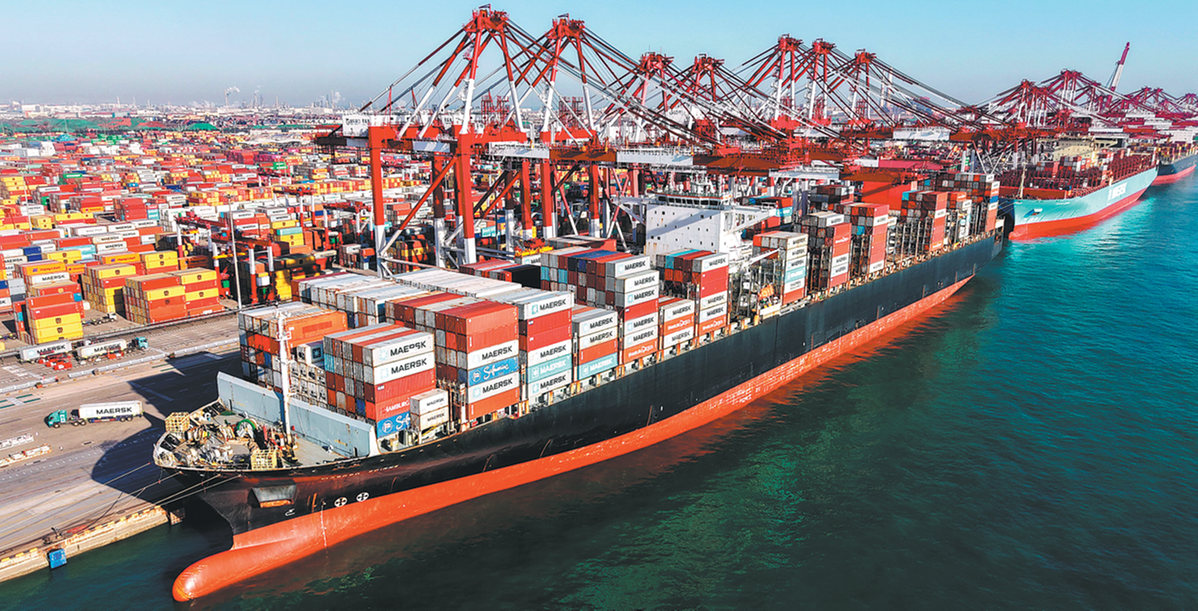
Container vessels are seen docked at Qianwan Container Terminal in Qingdao, Shandong province, on Dec 8. YU FANGPING/FOR CHINA DAILY
The world economy faced strong headwinds in 2025, primarily as a result of escalating trade tensions thanks to the US' "reciprocal tariffs", causing substantial uncertainties in supply chains and the global economy.
China, meanwhile, managed to maintain stable economic growth throughout the year, with a high possibility of achieving annual GDP growth of more than 5 percent, contributing about 30 percent of total global economic growth.
Starting in February, the United States imposed high tariffs on China and other trade partners, which went against the principle of free trade and dealt a heavy blow to global supply chains. Although China initiated countermeasures to force Washington back to the negotiating table and ultimately lower the tariffs, the damage had already been done, experts said.
"2025 was a challenging year for the world economy," said Gerard Lyons, a British economist who holds senior positions in several financial institutions in London. "The unpredictability of US policy and the impact of tariffs were the major events."
Apart from trade tensions, the ongoing conflict in Ukraine also affected investor mood across the globe, with the European economy suffering the most. Rising inflation also posed a threat to much of the developed world in 2025.
"The global economy has had to withstand a number of extraordinary body blows such as tariffs, continued conflict in Eastern Europe and a much more national interest focus for economies," said Aly-Khan Satchu, a leading investment banker from Kenya.
According to the International Monetary Fund, the global economy is adjusting to a landscape reshaped by new policy measures. Although some extremes of higher tariffs caused by US trade measures were tempered, the overall environment remains volatile, and temporary factors that supported activity in the first half of 2025, such as front-loading, are fading.
In its October World Economic Outlook report, the IMF forecast the global economy would slow from 3.3 percent in 2024 to 3.2 percent in 2025.
"The pattern in the global economy is clear and striking; the traditional economy is ex-growth or in recession while the innovation-driven economy is full steam ahead, and this great divergence explains economic growth across the globe," said Joyce Zhou, CEO of Oakcean Capital, a London-based wealth management company.

 首页
首页


 陕公网安备 61010302000964号
