
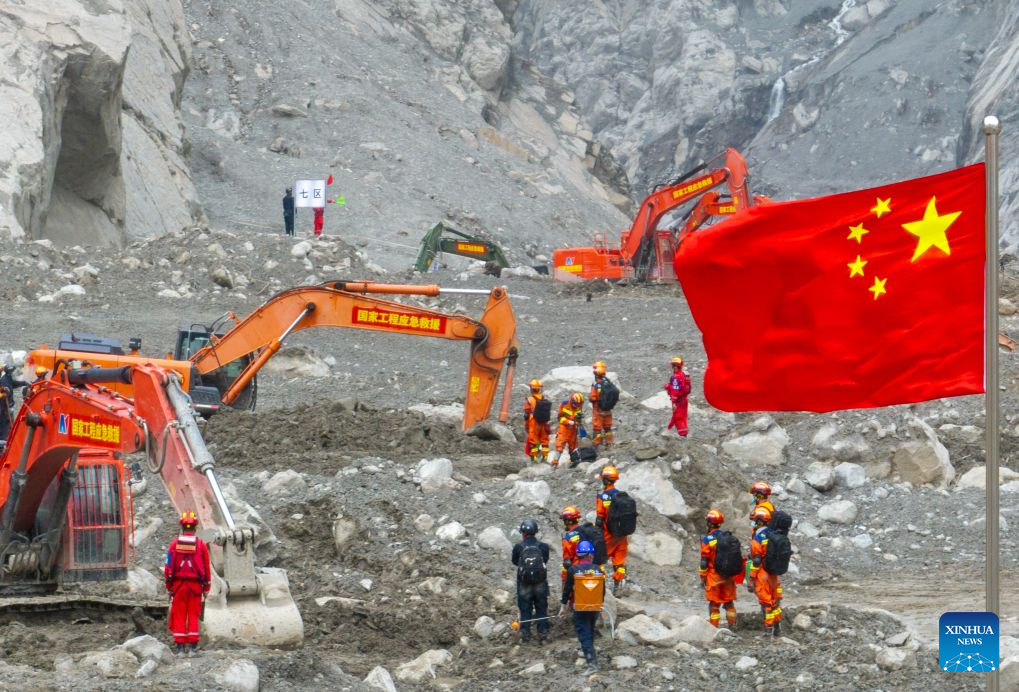
Rescue personnel work at the core affected zone of the mudslide-hit Gyirong Port in southwest China's Xizang Autonomous Region, Sept. 6, 2026. [Photo/Xinhua]
As of 6 p.m. on Sept. 5, the landslides triggered by a high-altitude glacier collapse in Nepal had left 43 people dead and 519 missing on the Chinese side. Meanwhile, two people had been rescued and 993 personal belongings had been recovered, officials told a press conference on Sept. 6.
After roads to the affected area were reopened at 10 a.m. on Sept. 2, authorities organized six specialized groups and seven search-and-rescue teams, local emergency response and rescue authorities said on Sunday. Using a coordinated approach that prioritizes access routes, divides affected areas into zones and brings together multiple forces, rescue teams have conducted multiple rounds of systematic searches across the core area of the disaster zone.
By 6 p.m. on Sept. 5, more than 2,500 rescue personnel had been deployed, along with more than 500 vehicles, over 9,000 pieces of rescue equipment and more than 1,000 drone flights. A total of 5.43 metric tons of supplies had also been delivered by air.
Search efforts have gone beyond locating survivors.
Authorities have used immigration records, communication data and location information to gather clues about missing people and verify their identities. For the families of those killed or missing, authorities have assigned dedicated personnel to maintain one-on-one contact, assist family members, respond to their concerns and provide psychological counseling.
For families anxiously waiting for news, a 24-hour dedicated hotline and assistance services have also been established. As of Sept. 5, the hotline had received 675 calls from families in China, and the reception center had received 791 family members and provided accommodation for 640 of them. Psychological support has also been offered to families affected by the disaster.
The rescue efforts have also focused on foreign nationals caught up in the disaster.
Authorities confirmed that 261 foreign nationals from 23 countries remain missing. China has shared relevant information with the embassies of the countries concerned and established a 24-hour hotline specifically for their families. The hotline had received 509 calls as of Sept. 5, officials said.
Meanwhile, special "green channels" were opened to facilitate the movement of foreign nationals and the transfer of relief supplies. China has facilitated the departure of 365 Nepali residents who wished to return home, and assisted in the safe departure of 279 Nepali vehicles and 103 truckloads of goods. China has also provided living assistance to 1,720 Nepali residents affected by the disaster.
Beyond the immediate rescue operation, China has been working with Nepal on disaster monitoring and recovery. Through the China-Nepal disaster-prevention information notification channel, China provides Nepal with daily updates on meteorological, hydrological, glacial and glacial-lake conditions.
At Nepal's request, the Chinese government has also dispatched experts specializing in tunnel rescue and DNA identification, while providing emergency relief supplies. The government of southwest China's Xizang Autonomous Region has offered Nepal 320 metric tons of Bailey bridge components and other disaster-relief materials.
"Thank you, China, for stepping in to support Nepal during such a devastating time," wrote a user of the social media platform X, formerly known as Twitter. "With so many people still missing and families desperately waiting for answers, the rescue teams and DNA experts will make a real difference."
"We sincerely thank the Chinese government for its rapid and comprehensive humanitarian assistance," wrote another X user, noting that satellite data and the deployment of technical experts were particularly important to rescue and recovery efforts.
As rescue operations continue, the figures on the ground show the scale of the response — from search teams and drones working in affected areas to dedicated services for families and assistance for foreign nationals.
For people still waiting for news of loved ones, however, the rescue effort ultimately comes down to one priority: finding those who remain missing and bringing them home.