


*The World Economic Forum (WEF)'s Global Risks Report 2026 points out that geopolitical and economic risks rise in a new age of competition.
*"Dialogue is not a luxury in times of uncertainty; it is an urgent necessity," said WEF President and CEO Borge Brende.
*Many experts believe that amid ongoing global turbulence, China's economy has demonstrated strong resilience and remains a major contributor to global growth.
by Xinhua writer Jiao Qian
DAVOS, Switzerland, Jan. 20 (Xinhua) -- The World Economic Forum (WEF) Annual Meeting 2026 opened on Monday in the Swiss Alpine town of Davos, bringing together nearly 3,000 representatives from over 130 countries and regions to discuss major defining issues amid mounting global risks and slowing growth.
Against a backdrop of growing geopolitical complexity, deepening fragmentation and rapid technological transformation, the forum has called on the international community to bridge differences through dialogue, look to the future, and work together to address major global challenges.
RISING GLOBAL RISKS
The world is currently grappling with a convergence of risks that is placing unprecedented strain on global stability and development.
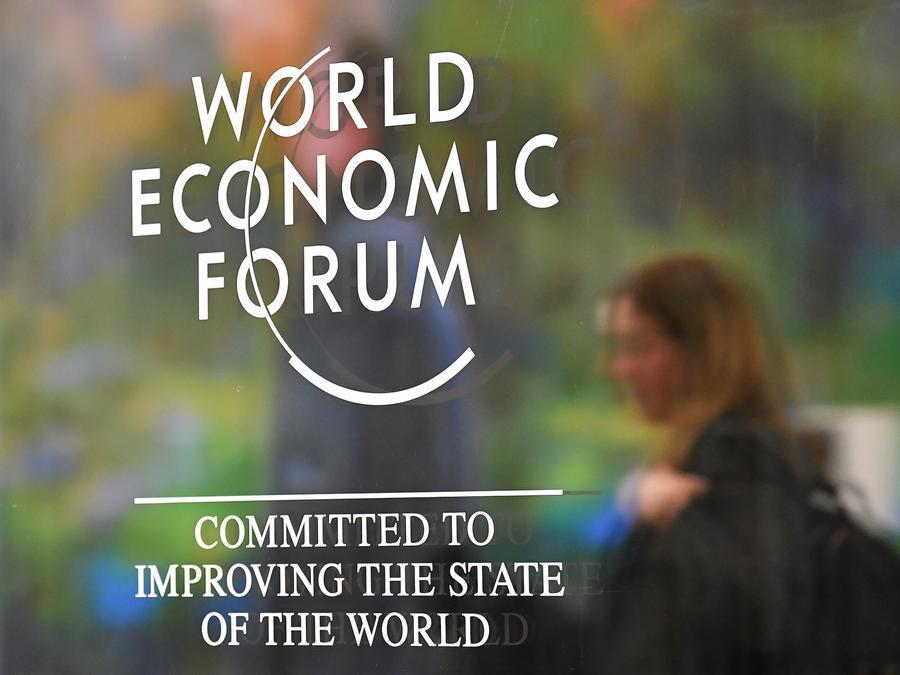
A participant walks past the logo of the World Economic Forum prior to the opening of its annual meeting, in Davos, Switzerland, Jan. 18, 2026. (Xinhua/Lian Yi)
The WEF's Global Risks Report 2026, one of its flagship publications released ahead of the annual meeting, points out that geopolitical and economic risks rise in a new age of competition.
The report identifies geoeconomic confrontation as the top risk for 2026, followed by interstate conflict, extreme weather, societal polarization, misinformation and disinformation. Economic risks, it notes, are rising at the fastest pace among all risk categories in the short term.
WEF Managing Director Saadia Zahidi said the age of competition compounds global risks ranging from geoeconomic confrontation, unchecked technology to rising debt, and changes the world's collective capacity to address them.
According to the WEF's latest Chief Economists' Outlook, 53 percent of chief economists expect global economic conditions to weaken in the year ahead, with concerns over potential asset valuation declines, mounting debt and geoeconomic realignment, among other factors.
This was echoed by the United Nations in its latest World Economic Situation and Prospects 2026 report. The UN projects global economic growth at 2.7 percent in 2026, slightly below the estimated 2.8 percent in 2025, citing weak investment and tight fiscal space as key drags on economic activity.
The report warns that higher tariffs combined with rising macroeconomic uncertainty will have a more pronounced impact next year, with global trade growth expected to fall to 2.2 percent in 2026, down from 3.8 percent in 2025.
In a recent interview with Xinhua, WEF President and CEO Borge Brende said, "We are most worried about major escalations of wars. That can kill global growth." He noted that if the world can avoid such escalations, global economic growth could reach over 3 percent in 2026.
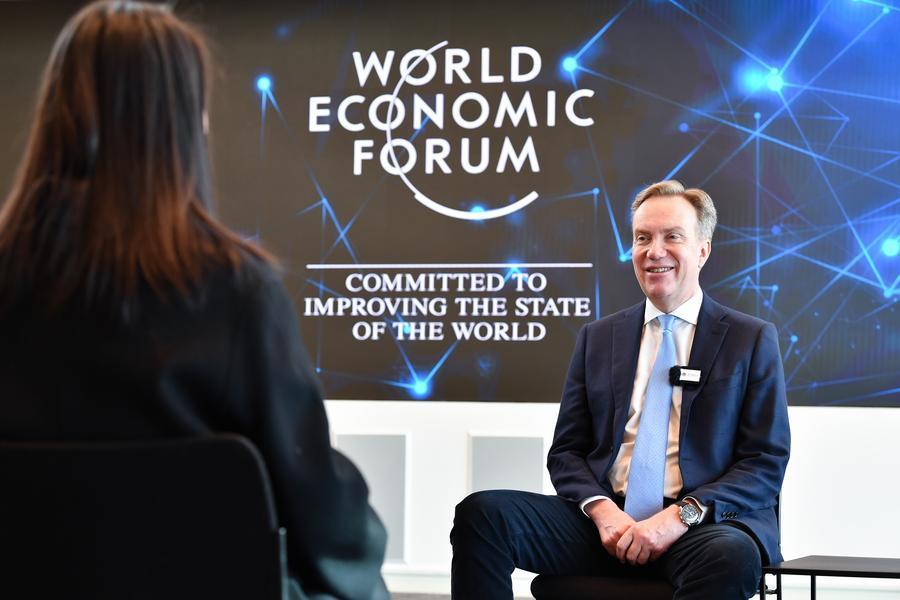
Borge Brende, president of the World Economic Forum (WEF), speaks in an interview with Xinhua in Geneva, Switzerland, Jan. 14, 2026. (Xinhua/Lian Yi)
A major focus of the annual meeting will be the technological paradigm shift -- from artificial intelligence (AI) and quantum computing to next-generation biotechnology and energy systems. The WEF said that these new technologies are reshaping how people live and work while creating new growth engines.
The WEF warns that while the rapid advance of AI is driving productivity gains, it also brings new risks, including social fractures fueled by rising unemployment and weakening consumer confidence.
DIALOGUE URGENTLY NEEDED
Days before the meeting opened, the WEF released its Global Cooperation Barometer, which finds that global cooperation has proved resilient despite strong headwinds confronting multilateralism. Yet the report cautions that existing levels of cooperation remain inadequate to meet pressing economic, security and environmental challenges.
The report stresses that in an increasingly complex and uncertain geopolitical environment, open and constructive dialogue is critical to identifying collaborative pathways that advance shared interests.
Under the theme "A Spirit of Dialogue," this year's meeting reflects that urgency. Key topics include how to cooperate in a more contested world, how to unlock new sources of growth, and how to deploy innovation at scale and responsibly.
"Dialogue is not a luxury in times of uncertainty; it is an urgent necessity," said Brende.
During the interview, he viewed dialogue as critical as it is the start of a process that can ultimately yield results capable of moving the world forward.
More dialogue is needed to change today's growing polarization and lack of win-win outcomes, Brende added.
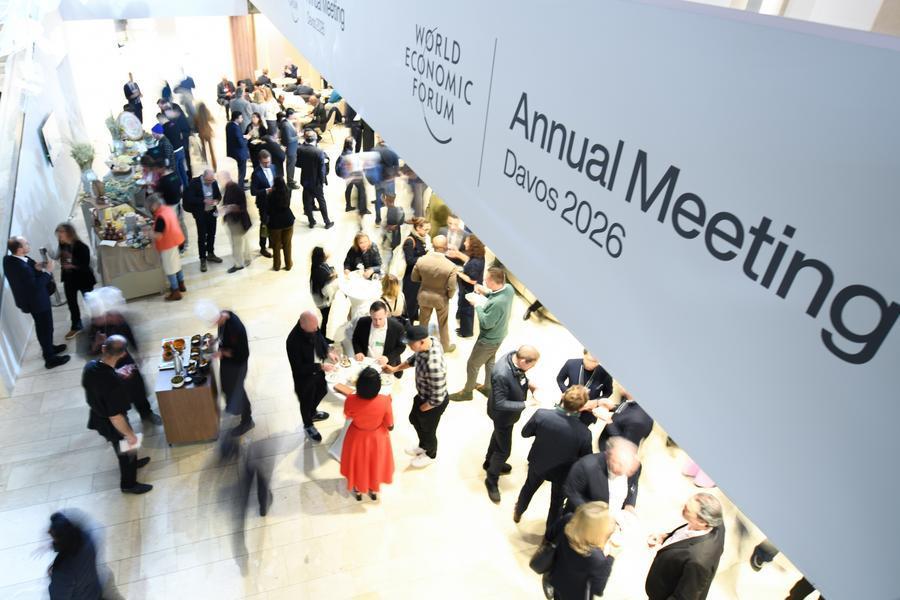
People attend the welcome reception at the 2026 annual meeting of the World Economic Forum (WEF) in Davos, Switzerland, Jan. 19, 2026. (Xinhua/Lian Yi)
Larry Fink, interim co-chair of the WEF, said the forum has brought together a record number of leaders from governments, businesses and non-governmental organizations at a moment when dialogue matters more than ever.
"Understanding different perspectives is essential to driving economic progress and ensuring prosperity is more broadly shared," he said.
CHINA'S CONTRIBUTION TO GROWTH
As the world's second-largest economy, China's role in global economic governance, green development and digital innovation has continued to draw attention ahead of the Davos meeting. Many experts believe that amid ongoing global turbulence, China's economy has demonstrated strong resilience and remains a major contributor to global growth.
Brende noted that China is witnessing increased growth in frontier technologies and is doubling down on investment in research, development and innovation.
"Technologies can represent huge opportunities for productivity gains and also growth in the years to come. And China is a major contributor to that," said Brende.
Philippe Monnier, former executive director of the Greater Geneva Berne area, the investment promotion agency for western Switzerland, said China has long been one of the main engines of global economic growth.
"Its vast market, investments abroad, and participation in international trade continue to support not only developing economies but also advanced ones," said Monnier.
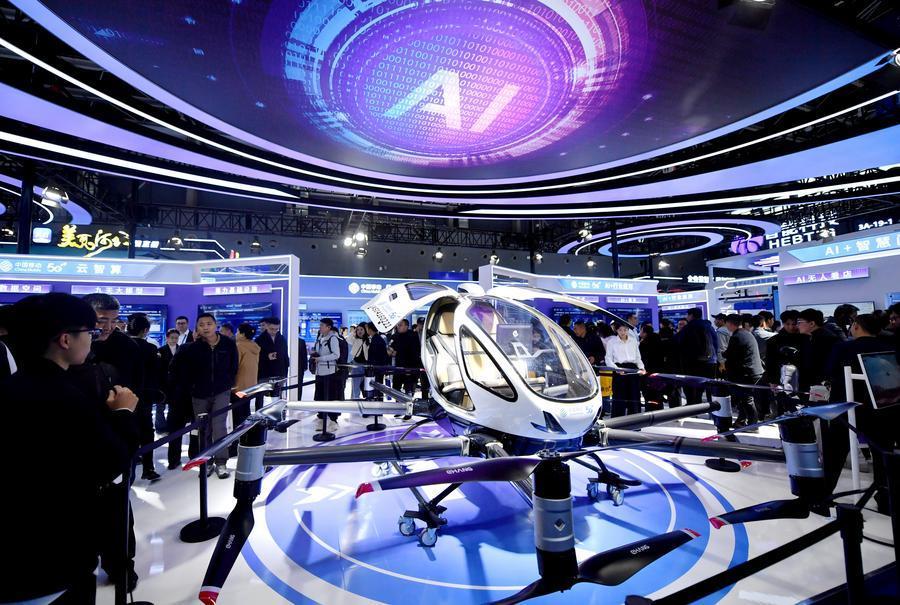
Visitors learn about a manned aircraft during the China International Digital Economy Expo 2025 in Shijiazhuang, north China's Hebei Province, Oct. 17, 2025. (Xinhua/Wang Xiao)
Li Nan, director of the Division on Investment and Enterprise at the UN Trade and Development (UNCTAD), has noted that Chinese enterprises are establishing a new paradigm for sustainable investment through their practices in the areas of clean energy, infrastructure, and the digital economy.
These efforts, she said, align closely with the UNCTAD's vision of promoting investment for sustainable development. They have also injected new momentum and confidence into post-pandemic global economic recovery and long-term stability, said Li.
Many experts, notably Brende, applaud China's contributions to promoting win-win cooperation.
"China has been underlining the importance of multilateralism," Brende said.
A multilateral system, centered on the United Nations, is needed for the world to address key global challenges, he said.
(Video reporters: Ma Ruxuan, Chen Binjie, Jiao Qian, Chen Junxia and Lian Yi; Video editors: Zhao Tianlin and Luo Hui.) ■
*The World Economic Forum (WEF)'s Global Risks Report 2026 points out that geopolitical and economic risks rise in a new age of competition.
*"Dialogue is not a luxury in times of uncertainty; it is an urgent necessity," said WEF President and CEO Borge Brende.
*Many experts believe that amid ongoing global turbulence, China's economy has demonstrated strong resilience and remains a major contributor to global growth.
by Xinhua writer Jiao Qian
DAVOS, Switzerland, Jan. 20 (Xinhua) -- The World Economic Forum (WEF) Annual Meeting 2026 opened on Monday in the Swiss Alpine town of Davos, bringing together nearly 3,000 representatives from over 130 countries and regions to discuss major defining issues amid mounting global risks and slowing growth.
Against a backdrop of growing geopolitical complexity, deepening fragmentation and rapid technological transformation, the forum has called on the international community to bridge differences through dialogue, look to the future, and work together to address major global challenges.
RISING GLOBAL RISKS
The world is currently grappling with a convergence of risks that is placing unprecedented strain on global stability and development.

A participant walks past the logo of the World Economic Forum prior to the opening of its annual meeting, in Davos, Switzerland, Jan. 18, 2026. (Xinhua/Lian Yi)
The WEF's Global Risks Report 2026, one of its flagship publications released ahead of the annual meeting, points out that geopolitical and economic risks rise in a new age of competition.
The report identifies geoeconomic confrontation as the top risk for 2026, followed by interstate conflict, extreme weather, societal polarization, misinformation and disinformation. Economic risks, it notes, are rising at the fastest pace among all risk categories in the short term.
WEF Managing Director Saadia Zahidi said the age of competition compounds global risks ranging from geoeconomic confrontation, unchecked technology to rising debt, and changes the world's collective capacity to address them.
According to the WEF's latest Chief Economists' Outlook, 53 percent of chief economists expect global economic conditions to weaken in the year ahead, with concerns over potential asset valuation declines, mounting debt and geoeconomic realignment, among other factors.
This was echoed by the United Nations in its latest World Economic Situation and Prospects 2026 report. The UN projects global economic growth at 2.7 percent in 2026, slightly below the estimated 2.8 percent in 2025, citing weak investment and tight fiscal space as key drags on economic activity.
The report warns that higher tariffs combined with rising macroeconomic uncertainty will have a more pronounced impact next year, with global trade growth expected to fall to 2.2 percent in 2026, down from 3.8 percent in 2025.
In a recent interview with Xinhua, WEF President and CEO Borge Brende said, "We are most worried about major escalations of wars. That can kill global growth." He noted that if the world can avoid such escalations, global economic growth could reach over 3 percent in 2026.
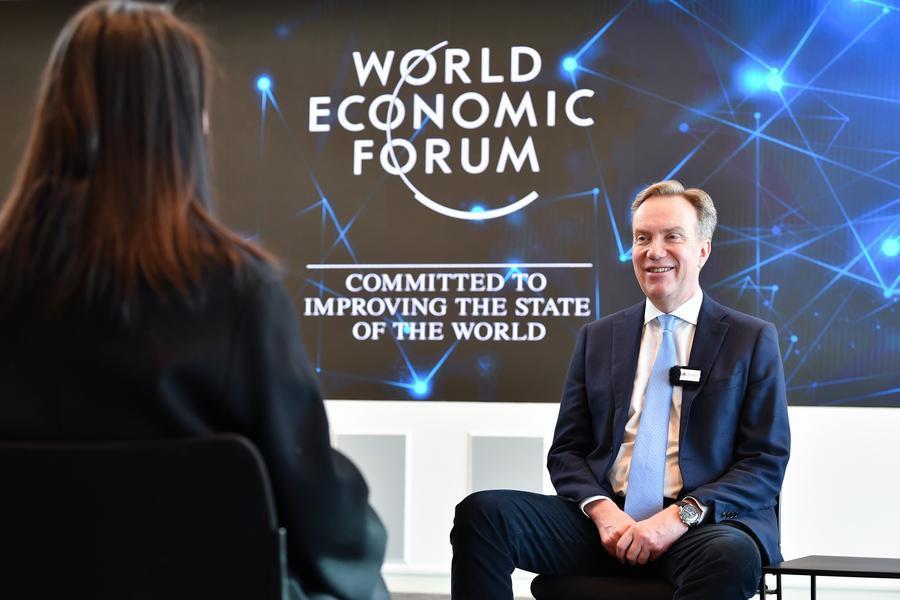
Borge Brende, president of the World Economic Forum (WEF), speaks in an interview with Xinhua in Geneva, Switzerland, Jan. 14, 2026. (Xinhua/Lian Yi)
A major focus of the annual meeting will be the technological paradigm shift -- from artificial intelligence (AI) and quantum computing to next-generation biotechnology and energy systems. The WEF said that these new technologies are reshaping how people live and work while creating new growth engines.
The WEF warns that while the rapid advance of AI is driving productivity gains, it also brings new risks, including social fractures fueled by rising unemployment and weakening consumer confidence.
DIALOGUE URGENTLY NEEDED
Days before the meeting opened, the WEF released its Global Cooperation Barometer, which finds that global cooperation has proved resilient despite strong headwinds confronting multilateralism. Yet the report cautions that existing levels of cooperation remain inadequate to meet pressing economic, security and environmental challenges.
The report stresses that in an increasingly complex and uncertain geopolitical environment, open and constructive dialogue is critical to identifying collaborative pathways that advance shared interests.
Under the theme "A Spirit of Dialogue," this year's meeting reflects that urgency. Key topics include how to cooperate in a more contested world, how to unlock new sources of growth, and how to deploy innovation at scale and responsibly.
"Dialogue is not a luxury in times of uncertainty; it is an urgent necessity," said Brende.
During the interview, he viewed dialogue as critical as it is the start of a process that can ultimately yield results capable of moving the world forward.
More dialogue is needed to change today's growing polarization and lack of win-win outcomes, Brende added.
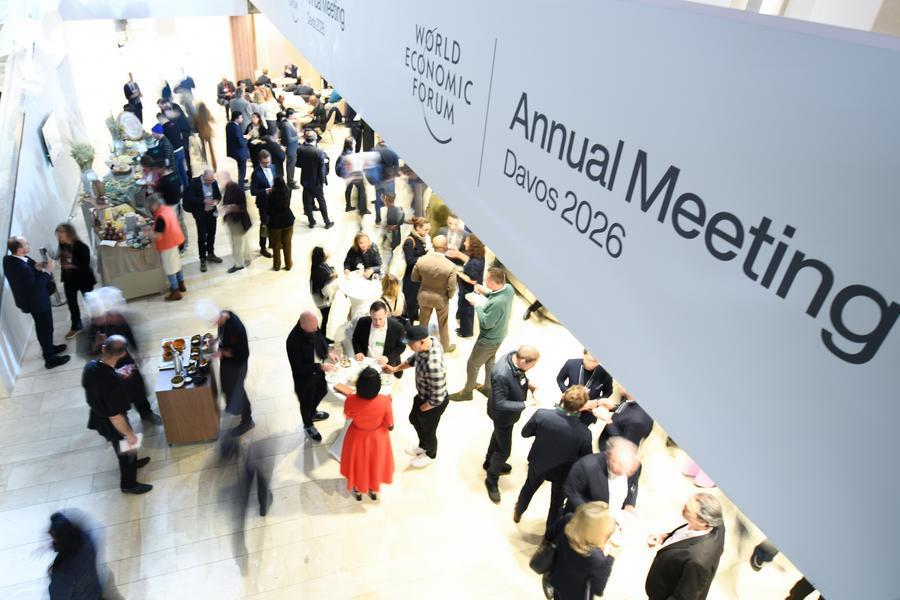
People attend the welcome reception at the 2026 annual meeting of the World Economic Forum (WEF) in Davos, Switzerland, Jan. 19, 2026. (Xinhua/Lian Yi)
Larry Fink, interim co-chair of the WEF, said the forum has brought together a record number of leaders from governments, businesses and non-governmental organizations at a moment when dialogue matters more than ever.
"Understanding different perspectives is essential to driving economic progress and ensuring prosperity is more broadly shared," he said.
CHINA'S CONTRIBUTION TO GROWTH
As the world's second-largest economy, China's role in global economic governance, green development and digital innovation has continued to draw attention ahead of the Davos meeting. Many experts believe that amid ongoing global turbulence, China's economy has demonstrated strong resilience and remains a major contributor to global growth.
Brende noted that China is witnessing increased growth in frontier technologies and is doubling down on investment in research, development and innovation.
"Technologies can represent huge opportunities for productivity gains and also growth in the years to come. And China is a major contributor to that," said Brende.
Philippe Monnier, former executive director of the Greater Geneva Berne area, the investment promotion agency for western Switzerland, said China has long been one of the main engines of global economic growth.
"Its vast market, investments abroad, and participation in international trade continue to support not only developing economies but also advanced ones," said Monnier.
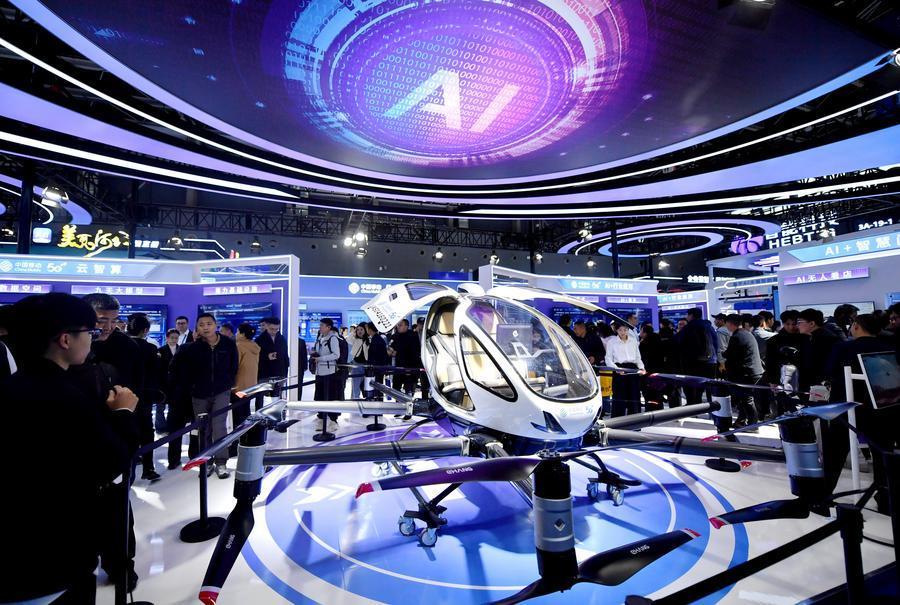
Visitors learn about a manned aircraft during the China International Digital Economy Expo 2025 in Shijiazhuang, north China's Hebei Province, Oct. 17, 2025. (Xinhua/Wang Xiao)
Li Nan, director of the Division on Investment and Enterprise at the UN Trade and Development (UNCTAD), has noted that Chinese enterprises are establishing a new paradigm for sustainable investment through their practices in the areas of clean energy, infrastructure, and the digital economy.
These efforts, she said, align closely with the UNCTAD's vision of promoting investment for sustainable development. They have also injected new momentum and confidence into post-pandemic global economic recovery and long-term stability, said Li.
Many experts, notably Brende, applaud China's contributions to promoting win-win cooperation.
"China has been underlining the importance of multilateralism," Brende said.
A multilateral system, centered on the United Nations, is needed for the world to address key global challenges, he said.
(Video reporters: Ma Ruxuan, Chen Binjie, Jiao Qian, Chen Junxia and Lian Yi; Video editors: Zhao Tianlin and Luo Hui.) ■

 首页
首页


 陕公网安备 61010302000964号
