
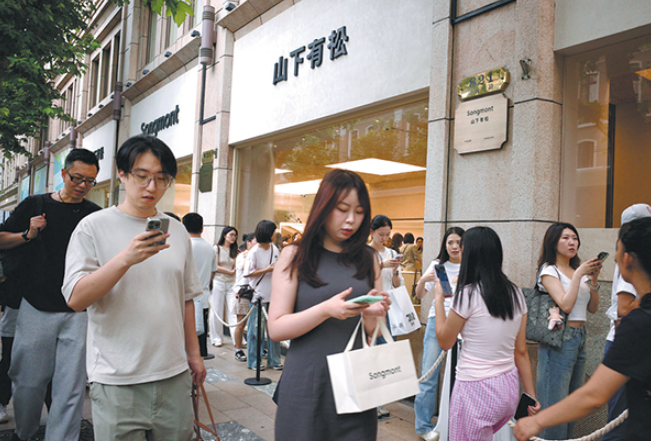
Customers wait in line outside a Songmont store on Huaihai Middle Road in Shanghai on Saturday, waiting to enter and shop. [Photo by Gao Erqiang/China Daily]
On an August afternoon in Shanghai, Mara-Kristin Lutz stepped out of the Songmont boutique, clutching the coveted tote bag that had topped her city break shopping list.
The Austrian fashion industry veteran — who had previously worked at Louis Vuitton — had researched the brand's latest collections on social media long before touching down in China. It was the bag's understated craftsmanship and thoughtful design language that won her over.
She was now dressed almost entirely in Chinese brands with her jacket and sun mask both from Chinese sports brand Anta. She also carried a bottle of perfume she had just purchased the day before from Chinese aromatherapy brand To Summer, and has placed other orders on Chinese online shopping platform Taobao.
Lutz's carefully curated shopping list is no longer an isolated quirk — it has become a hallmark of the surging wave of international visitors to Shanghai. As China's expanding visa-free policies fuel an inbound tourism boom, shopping for quality products from the country's homegrown brands has emerged as a cultural trend for global travelers.
According to the State Taxation Administration, the number of foreign travelers claiming departure tax refunds surged 366 percent year-on-year in the first half of the year, while the value of refunded goods and payouts grew 69 percent. From January to May, Shanghai Customs verified 201,000 tax refund applications, with sales reaching 1.92 billion yuan ($285 million) — year-on-year increases of 300 percent and 62 percent, respectively.
Like Lutz, a growing number of foreign tourists touch down with meticulously curated shopping lists already in hand.
Russian traveler Evgeniya Azarenkova did extensive research before coming to Shanghai. She said she believes that Chinese brands have their own design identity. "The silhouette is different. It always has this character that makes it different."
Lutz also praised the exceptional quality of Chinese products. "There is still a stigma in Europe that it's only bad quality in China, and this is totally not the case anymore," she said. "(In some cases) it's even higher quality compared to Europe, and the pricing is more affordable."
The price advantage is clear. According to Jiefang Daily, a pair of sneakers from popular domestic footwear brand Pane costs around 800 yuan, about 30 percent lower than comparable styles from top international brands.
According to Pane, its overseas social media following surged from just over 30,000 in September 2025 to more than 140,000 by June, with overseas visitors accounting for roughly 30 to 40 percent of foot traffic at its Shanghai store.
The final push to purchase, however, rarely comes from social media or brand promotion, but from the tactile experience of seeing and touching the product firsthand.
Another Russian traveler, Irina Rudometova, bought Pane sneakers as souvenirs. "They're comfortable and I like the design," she said, highlighting the shopping experience itself. "I like the lights and geometric forms inside (the store) — the atmosphere and the smell. For me, it's about atmosphere, not about the stuff."
More important, beyond the transactions, visitors' perceptions are rapidly shifting from "made in China" to "designed in China".
"When we were growing up, seeing something 'made in China' meant something cheap, but right now it's changing a lot. It may be the same price as a well-known foreign brand, but the quality is different, the style is different — very authentic," said Azarenkova, the traveler from Russia.
Zhang Zihan, founder of An Action A Day, a domestic activewear brand launched four years ago, views this shift in a broader context.
"Chinese brands are gradually entering the global mainstream — not only through affordability, but through core product strength, culture and aesthetics. This trend is also expanding from traditional categories, such as automobiles and consumer electronics, to everyday consumer goods," she said.
Zhang noted that markets in Europe and the United States account for 85 percent of the brand's cross-border sales.
Industry insiders said the biggest edge that Chinese brands have is the all-around competitive strength they've built up in the country's massive, fast-moving local market.
"We have accumulated experience interacting with a vast and dynamic base of Chinese consumers, and we have already withstood the most direct and rigorous scrutiny from them," Zhang added.
Chen Tianyi contributed to this story.